Latest News

Latest News

California’s Wildfire-Driven Forest Loss Ranks Among the World’s Highest

California is now one of the global hotspots for wildfire‑driven deforestation, according to new research led by UC Davis forest and fire ecologist Dr. Hugh Safford. A study published in Frontiers in Forests and Global Change finds that between 1991 and 2023, California lost an estimated 6–11% of its conifer forests, with rates of fire‑driven forest loss far exceeding the global average.

2026 FIELD CREW POSITIONS

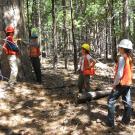
The lab of Dr. Hugh Safford at UC Davis is looking to hire crew members for a seasonal field team to collect data on the effects of vegetation management/fuel reduction and wildfire on forest vegetation, fuels, plant diversity, and other pertinent variables over periods of 5-25 years since sites were affected by wildfire. 

This work will support management efforts by the US Forest Service Lake Tahoe Basin Management Unit (LTBMU) and the California Tahoe Conservancy.

ShrubWISE Data Challenge

The Wildfire Science & Technology Commons is hosting the ShrubWISE Data Challenge, an open competition focused on improving high-resolution mapping of shrub ecosystems using geospatial data and machine learning. The challenge invites researchers, students, and data scientists to develop workflows that can map shrub cover and height at ~1-meter resolution—information that is critical for understanding fuels, wildfire behavior, and ecosystem dynamics.

The competition runs from February 19 to April 19, 2026, with results announced on May 1, 2026.

Job Opening - Field crew 2026 positions

Under the general supervision of the PI the 6 Field Crew positions will consist of two different crews (three people in each), working one after the other to a maximum of 1000 hours each. The Field Crew positions require following several established data collection protocols. The protocols relate to measuring shrub species and some trees; to destructively sample individuals of target species; to collect litter; and to sample soils.

Lessons from the Caldor Fire’s Christmas Valley “Miracle”

The 2021 Caldor Fire stands as one of the most significant wildfires in recent western U.S. history, scorching more than 222,000 acres and forcing tens of thousands of residents to evacuate. Yet within the Lake Tahoe Basin, the communities of Christmas Valley and Meyers experienced what forest managers have called the “Christmas Valley miracle”—a striking example of how strategic pre-fire treatments can protect both forests and people’s homes. 

Climbing to Extremes: Tracking High-Elevation Jeffrey Pines in the Sierra Nevada

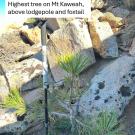
The research team, led by Hugh Safford and his students and collaborators, were surprised to find Jeffrey pines at elevations above 11,000 feet—which is several thousand feet higher than where the species has long been documented. 

To find them, the team hiked rugged terrain: over 240 miles, 24 peaks, and multiple weeks of fieldwork including off-trail boulder fields and high alpine slopes. 

2025 Job Opening for Undergraduate Student at the Safford Lab (STDT 3 Lab Research Assistant)

Dr. Hugh Safford’s lab at UC Davis is seeking to hire an undergraduate student to conduct laboratory work on a project involving vegetation, fuels, biomass, and prescribed fire monitoring. The project utilizes plot sampling, destructive biomass sampling, and Terrestrial Lidar Systems (TLS).

This position supports the project "Scaling Up Science-Based Vegetation Treatments for a Wildfire-Resilient California" a collaboration between UC San Diego, CAL FIRE, UC Davis, UC Berkeley, and USF.


Burning Question: How to Save an Old-Growth Forest in Tahoe

On the shores of Lake Tahoe at Emerald Bay State Park grows what some consider to be the most iconic old-growth forest in the Lake Tahoe Basin. Giant ponderosa pines — some of the last remaining in the area — share space with at least 13 other tree species.

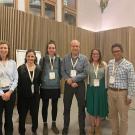
Safford Lab organize the session "Advances in forest restoration, management and adaptation in the Mediterranean climate zone of North America" ​​at the 8th Mediterranean Forest Week


The 8th Mediterranean Forest Week (8MFW) took place from 11 to 15 November in Barcelona, ​​Spain. The Mediterranean Forest Week (MFW) is a biennial event that serves as a platform for cooperation between researchers, policy makers and stakeholders, fostering dialogue on the challenges facing Mediterranean forests.